

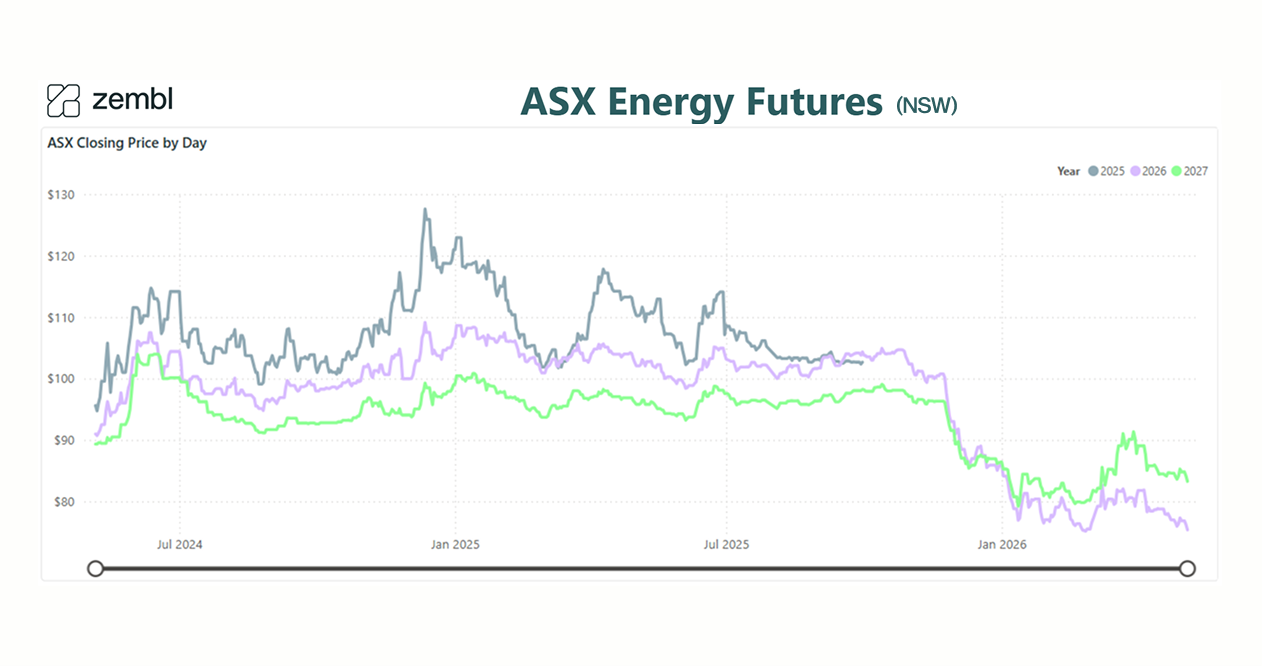

April closed with NSW Calendar 2026 ASX futures at fresh two-year lows.¹ Calendar contracts lock in the wholesale electricity price for a full year, so Cal 2026 covers January to December 2026 and Cal 2027 covers all of 2027. Right now, Cal 2027 is sitting just above Cal 2026, which usually means traders expect prices to lift slightly next year rather than fall further. The chart below shows NSW, but QLD, VIC and SA are tracking similar trends, with Cal 2026 contracts at or near two-year lows across all four states.¹ The curve has steadily softened since the mid-2025 peaks, though global headlines and recent spot data suggest a floor could be forming.
Global context
Renewed Middle East tensions and disruption around the Strait of Hormuz, which carries roughly 35% of the world's seaborne crude, have pushed oil past A$167 a barrel at points this year.² The World Bank now expects Brent crude (the global oil benchmark) to average around A$120 a barrel in 2026, up from A$96 in 2025.³ Qatari Liquefied Natural Gas (LNG), most of which transits Hormuz, is feeling the same pressure. In Australia, gas is mainly used to cover periods of high electricity demand, such as cold winter mornings or hot summer afternoons. When global gas prices rise, the cost of running those gas peaking plants rises with them, and that ultimately flows through to wholesale electricity prices and the rates retailers offer businesses.
Australian landscape (April 2026)
- Mild weather through April kept electricity demand low, which has been one of the main drivers behind the downward trend in wholesale prices and futures contracts.
- NSW ASX futures kept softening through April. Cal 2026 closed the month around $93/MWh, down from about $97/MWh at the start of April and well below the ~$120/MWh seen this time last year.¹
- QLD, VIC and SA followed similar paths, with Cal 2026 contracts at or near two-year lows across all four mainland states.¹
- Batteries are now setting the wholesale price more often than any other technology during the evening peak in every mainland state. Grid-scale battery revenues across the NEM rose 19% month-on-month in April to around $53,000/MW/year.⁴
- Around 30 GW of battery storage is now in development across the NEM, helping push gas-fired generation demand below earlier forecasts and continuing to displace coal in the daytime market.⁵
What might happen next
- Next 3 months: As the weather turns colder and homes and businesses crank up the heating, electricity demand will climb. That's when gas peaking plants tend to kick in to cover the spikes, and with oil and global gas prices already elevated, any sustained cold snap could push wholesale prices and futures up quickly from their current lows. June is also the second-busiest contracting period of the year behind December, with a high share of commercial contracts expiring then, which adds buying pressure on the curve.
- Next 6 months: New batteries and solar coming online should help keep wholesale prices contained outside the peak periods. Conflict escalation around the Strait of Hormuz or extreme weather remain the main swing factors.
- Next 12 months: With around 30 GW of battery storage in development across the NEM⁵ and major coal units approaching retirement, the shift away from coal and gas continues. Cal 2027 sitting only modestly above Cal 2026 reflects that view.⁶
Why this matters
Energy prices move on global news, weather and infrastructure decisions made years ago. Wholesale prices are just one input. Networks, retailer margins and risk premiums all sit on top, but the shape of the futures curve is the clearest read on where the market thinks things are heading.April is typically the lowest point on the calendar for wholesale electricity prices, and this year the downward trend has continued into early May. With winter demand, the busy June contracting period and global headlines all sitting between now and the back half of the year, the current window is the one to watch for any business with a commercial electricity contract expiring in the next 12 months.
Thanks for reading Zembl's April market wrap. The May edition lands in early June.
Sources
- ASX Energy Futures (NSW) closing price data, April 2026: https://www.asxenergy.com.au/
- World Bank Commodity Markets Outlook, April 2026: https://www.worldbank.org/en/news/press-release/2026/04/28/commodity-markets-outlook-april-2026-press-release
- Impact Wealth – Oil Price Surge 2026: How Middle East Tensions Are Impacting Global Markets: https://impactwealth.org/oil-price-surge-2026-middle-east-global-impact/
- Modo Energy – Australia NEM BESS Forecast: April 2026 release: https://modoenergy.com/research/en/australia-nem-bess-forecast-april-2026-release
- Utility Magazine – Battery boom cuts gas use to lowest level in decades: https://utilitymagazine.com.au/battery-boom-cuts-gas-use-to-lowest-level-in-decades
- AEMO Quarterly Energy Dynamics Q1 2026 (background context): https://www.aemo.com.au/-/media/files/major-publications/qed/2026/qed-q1-2026.pdf
.png)
.png)

.svg)

