


If you have ever looked at a commercial electricity bill, seen a charge labelled "demand" or "capacity", and moved on without thinking too hard about it, you are not alone. And you may be paying more than you need to.
Demand charges are one of the most consistently misunderstood components of a business energy bill. They behave differently to the usage charges most people instinctively focus on. They can represent a substantial share of total cost. And small operational changes can meaningfully reduce them, but only if the business understands what is actually being measured.
What demand charges actually measure
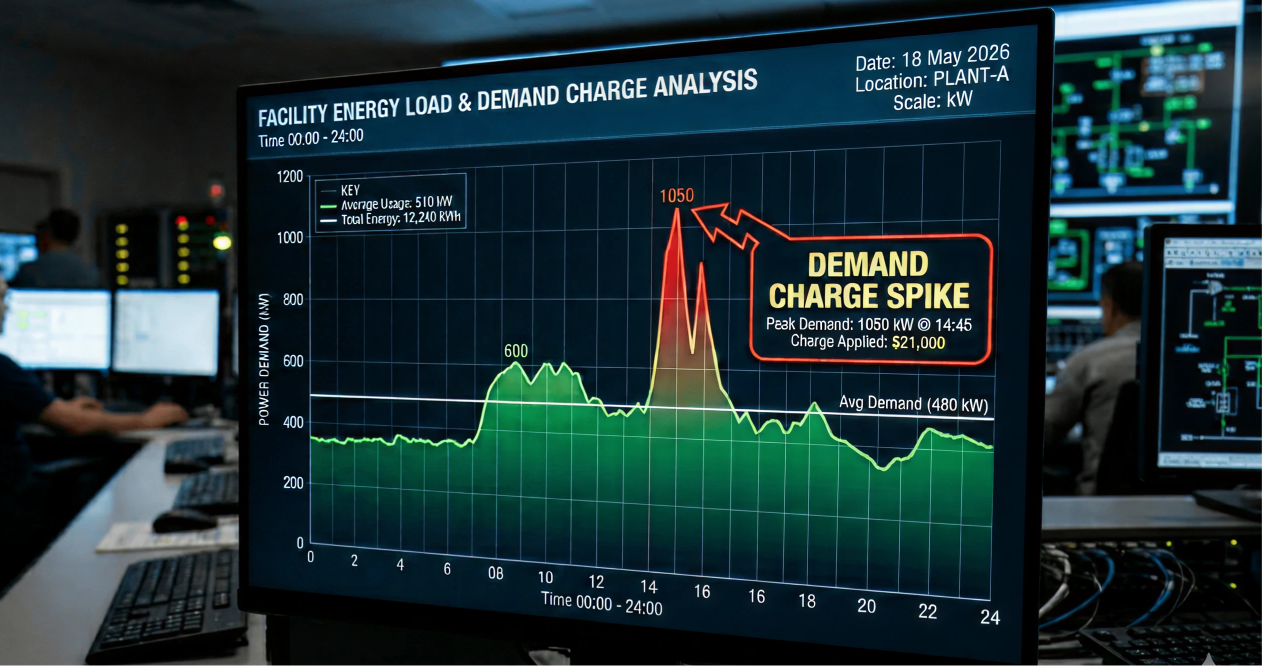
Your usage charge (measured in kWh) captures the total energy your site consumed over the billing period. Your demand charge (measured in kW or kVA) captures how hard the grid had to work for you at your peak moment, usually the highest recorded demand interval within the billing period or a defined demand window.
Usage is the marathon. Demand is the sprint.
Take the example of a golf club. If you decide to charge all of the buggies at once, you are putting more strain on the grid at that moment and are likely to receive a higher demand charge. Stagger the charging across the day and you spread the demand, reducing the peak and the charge that comes with it.
The grid and the network are sized for peaks, not averages. That is why networks recover a significant portion of their costs through demand-based charges: the infrastructure supporting a site has to be specified to handle the site's worst hour, not its average one.
Why this matters on the bill
Depending on network zone and tariff structure, demand charges can represent a material share of total network costs, sometimes comparable to, or larger than, the energy usage component itself.
The challenge is that a single spike, one hour of unusually high simultaneous load, can reset the demand charge for an entire billing period. Under some tariff structures, it can influence charges well beyond the current billing cycle. A business can reduce average consumption, improve efficiency, and still see no meaningful improvement in the demand line, because one outlier moment is still setting the rate.
What drives a demand peak
Demand peaks rarely come from the equipment people first suspect. They come from coincidence: multiple loads drawing power simultaneously. A chiller cycling on while compressed air is running while ovens are preheating while production is at full tilt. Individually, none of it is unusual. Collectively, at the same five-minute window, it becomes the site's demand peak.
That is why demand management is an operational conversation as much as a commercial one. The ability to stagger start-up sequences, manage HVAC cycling, coordinate production scheduling, or automate load control can move the demand peak down without reducing output.
.png)
Why demand management is a missed opportunity
Demand charges also differ significantly across network tariff structures. The same site, assigned to two different network tariffs, can see very different demand exposures, even before any operational changes are made.
Reviewing whether the site is on the most suitable eligible demand tariff is a specialist exercise. It depends on the site's load factor, its peak-to-average ratio, the seasonality of its operations, and the structure of the available network tariffs in its zone. Getting it wrong is expensive. Getting it right is often the single highest-return commercial decision a site can make without touching a piece of equipment.
How Zembl helps
We use our energy expertise to analyse your site's interval data and identify opportunities to optimise your network tariff. That includes examining how and when peaks are forming, modelling the site against alternative tariff structures, and identifying whether the peak is a behavioural or infrastructure issue. Where a tariff change is appropriate, we prepare the case and liaise with the network for approval. It is worth noting that network approval is required and not guaranteed: networks assess each request on its merits and may decline where infrastructure investment or upcoming tariff changes affect the outcome.
Demand is not a mystery. It is a measurable, manageable line item. The businesses that treat it that way keep the savings the rest of the market walks past.
Get in touch with a Zembl Energy Expert today.
.png)
.png)
.png)

.png)
.svg)

