

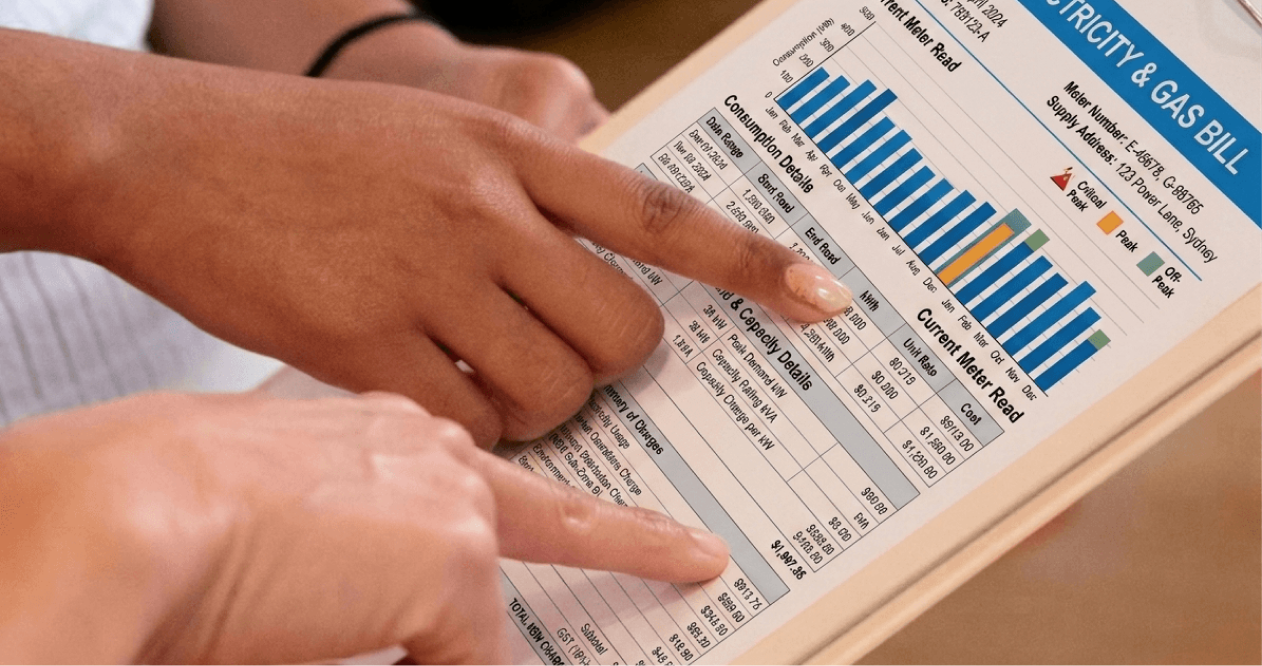

With everything else going on for a business, it is easy to assume the energy bill is always correct. The invoice arrives, the amount looks plausible, and payment gets approved.
But behind every energy bill sits a complex chain of contracts, meter data, network tariff structures, market charges, and regulatory calculations, all of which need to align for the final figure to be accurate. In complex commercial and industrial environments, billing anomalies are not uncommon. Most go undetected because no one is checking with the right tools, and the cost compounds quietly.
What bill validation actually means
A proper energy bill validation is a line-by-line reconciliation of what the bill says against what the contract, the meter data, the assigned network tariff, and the current regulatory settings actually require.
It asks questions the bill itself cannot answer:
- Is the contracted retail energy rate being correctly applied?
- Has the business been assigned the correct network tariff by the distributor, and are the charges on the bill consistent with that tariff?
- Have environmental scheme costs been calculated against the right volume at the right rate?
- Is the meter data on the bill consistent with the data from the metering coordinator?
- Have any manual adjustments, estimates, or true-ups been applied correctly?
Many of these issues can be identified and resolved when caught early.
Why it matters more than people think
Energy invoices are complex. They involve multiple parties: the retailer, the network, the metering coordinator, and the market operator. Errors are not the result of malice. They are the result of complexity. Pass-through misalignments, tariff reclassifications after a meter change, billing based on estimates rather than actuals, incorrectly applied demand resets: these are structural issues in the way the market processes data, not accusations against any individual retailer.
The consequence is that billing anomalies in complex commercial & industrial environments can persist across multiple billing cycles before anyone notices. The cost is real, even if it is invisible on a single invoice.
.png)
Why businesses rarely catch it
Validating an energy bill properly requires three things most businesses do not have in-house: specialist energy knowledge, access to the underlying meter and network data that sits behind the invoice, and the time to run a rigorous review for every billing cycle.
Energy invoices are designed to be paid, not audited. The detail required to validate them is rarely visible on the face of the invoice. The interval data, the full contract pricing schedule, the current network tariff structure, and the compliance frameworks behind environmental charges all sit outside the invoice itself. Without them, any review is a best-effort exercise, not a rigorous one.
How Zembl delivers it
With every new energy contract procured, Zembl validates the first bill against the customer's contract, meter data, and current network and regulatory settings. Where errors are found, we raise them with the retailer and manage the resolution through to credit. We then continue with regular bill validations every six months for the life of the contract.
The customer does not have to become an energy expert. That is our job. Their job is to trust that the number on the invoice is the number they actually owe.
Get in touch with a Zembl Energy Expert today.
.png)
.png)
.png)

.png)
.svg)

