


Quick summary
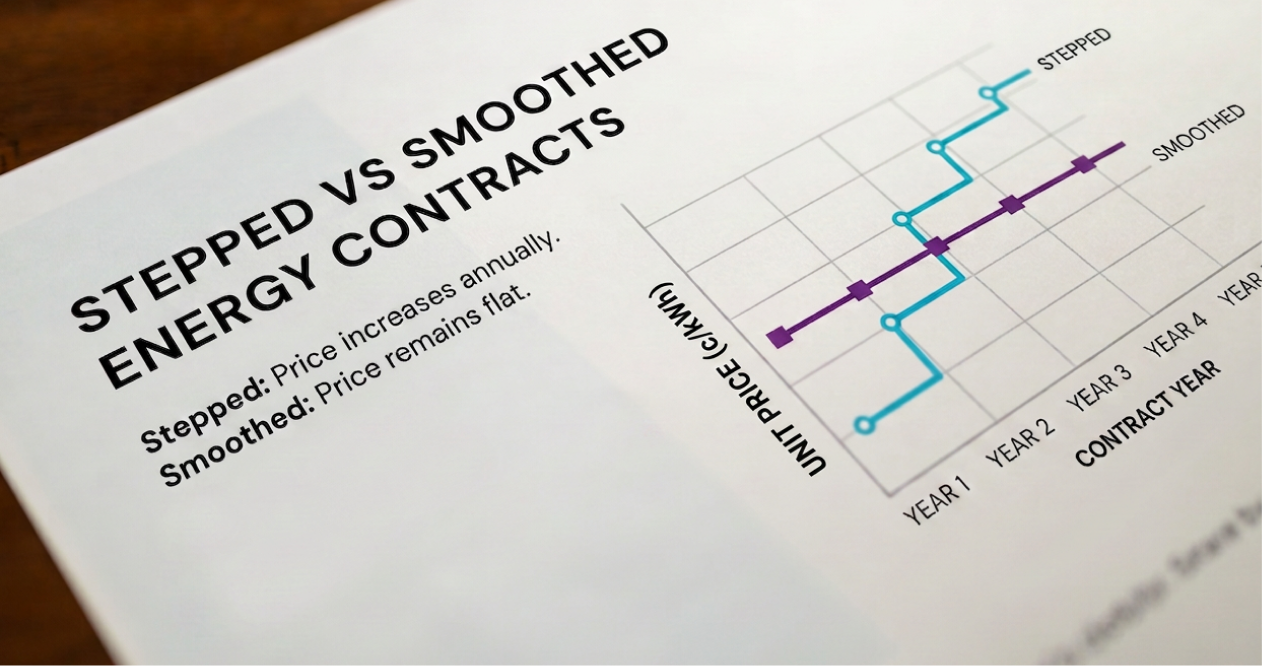
Stepped and smoothed contracts are two different ways your energy rates can be structured across your contract term. Stepped contracts have set rates that can increase or decrease from year to year, depending on market forecasts when the contract is agreed. Smoothed contracts generally apply the same retail rate across the contract term. Both give you visibility of your rates upfront. The key difference is whether you prefer a stable rate across the contract term or are comfortable with known yearly rate changes.
Key takeaways
- Stepped contracts lock in yearly rate changes. You know the agreed rate for each year from the start of the contract, and those rates stay fixed even if market prices change during the contract term.
- Smoothed contracts apply a consistent retail rate across the contract term, rather than having different rates from year to year. This provides greater rate stability, while your actual energy bill will still vary depending on factors such as how much energy your business uses.
- Stepped and smoothed rates are generally very similar over the full contract term. The key difference is how those rates are structured, with stepped rates changing at set points and smoothed rates remaining consistent across the contract term.
- The right choice depends on your business. Smoothed rates may suit businesses that prefer rate stability across the contract term, while stepped rates may suit businesses that are comfortable with agreed rate changes from year to year.
- Before you sign, ask your broker to show you how the annual rates compare under each option. This can help you understand the difference between a stable rate across the contract term and rates that change from year to year.
When you’re reviewing a commercial energy contract, the rate is only part of the picture. How that rate is structured across the contract term can also matter.
That’s where stepped and smoothed pricing comes in.
Both structures can spread the same underlying energy costs in different ways. The key difference is when you pay those costs.
Understanding that difference can help you assess what your commercial energy bills could look like over the contract term and choose a structure that better suits your budget and cash flow.
What is a stepped energy contract?
A stepped contract sets different energy rates for different periods of your contract.
For example, on a three-year agreement, you might have one rate in year one, a different rate in year two, and another in year three.
Your energy rate can increase or decrease from one year to the next, depending on the rates agreed with the retailer at the start of the contract.
With a stepped contract, you know the applicable rate for each period from the outset. This gives you a clear view of when your agreed energy rates will change across the contract term.
If the agreed rate increases in a later year, the energy rate component of your bill will increase, assuming your usage stays the same.
What is a smoothed energy contract?
A smoothed contract applies a consistent agreed energy rate across the contract term.
Rather than having a different rate for each year, you pay the same blended rate across the contract period.
For businesses that prefer rate stability, this can be useful. A consistent contracted rate can make it easier to plan ahead and avoid year-to-year changes in the energy rate component of your bill.
You may effectively pay more of those costs earlier in the contract and less later compared with a stepped structure, or vice versa.
Stepped vs smoothed: A simple example
Say a NSW business is considering a three-year energy contract from 2027 to 2029. Here’s a simple example of how its peak rates could be structured:
With the stepped option, the agreed rate changes each year. With the smoothed option, the rate remains consistent across the three-year contract term.
In this example, the rates are very similar across the full contract term. The key difference is how they’re structured from year to year.
This gives businesses a clearer way to compare rate stability versus known yearly rate changes when considering their options.
How Zembl can help
Comparing commercial energy rates can involve more than choosing between stepped and smoothed pricing.
Zembl Energy Experts can go to market on your behalf, secure competitive commercial energy pricing from our retailer panel, and help you understand the options available to your business.
We’ll take you through the available rates, how they’re structured across the contract term, and the key considerations so you can make an informed decision based on what works for your business.
Remember: when it comes to commercial energy procurement, understanding what you’re signing matters just as much as the rate.

.png)
.png)
.png)

.png)
.svg)

