
Key takeaways
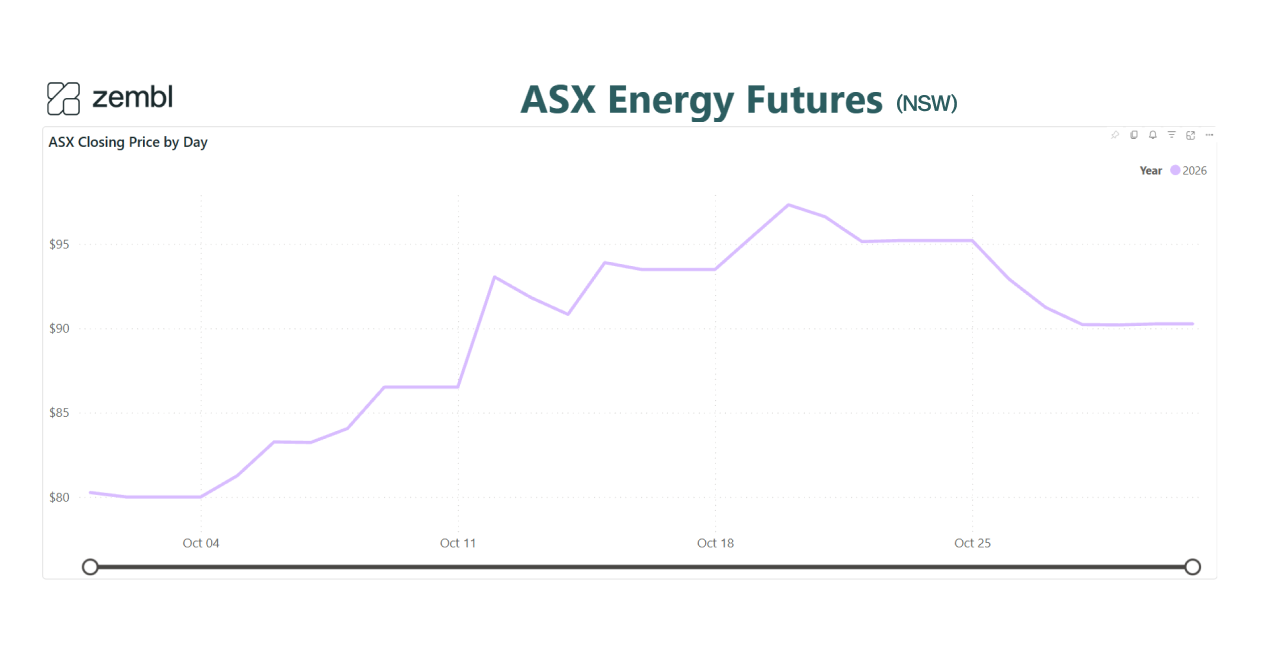
- NSW futures for 2027 rose from $80.26 to $90.26 over October, up 12.5%. Every state moved the same way.
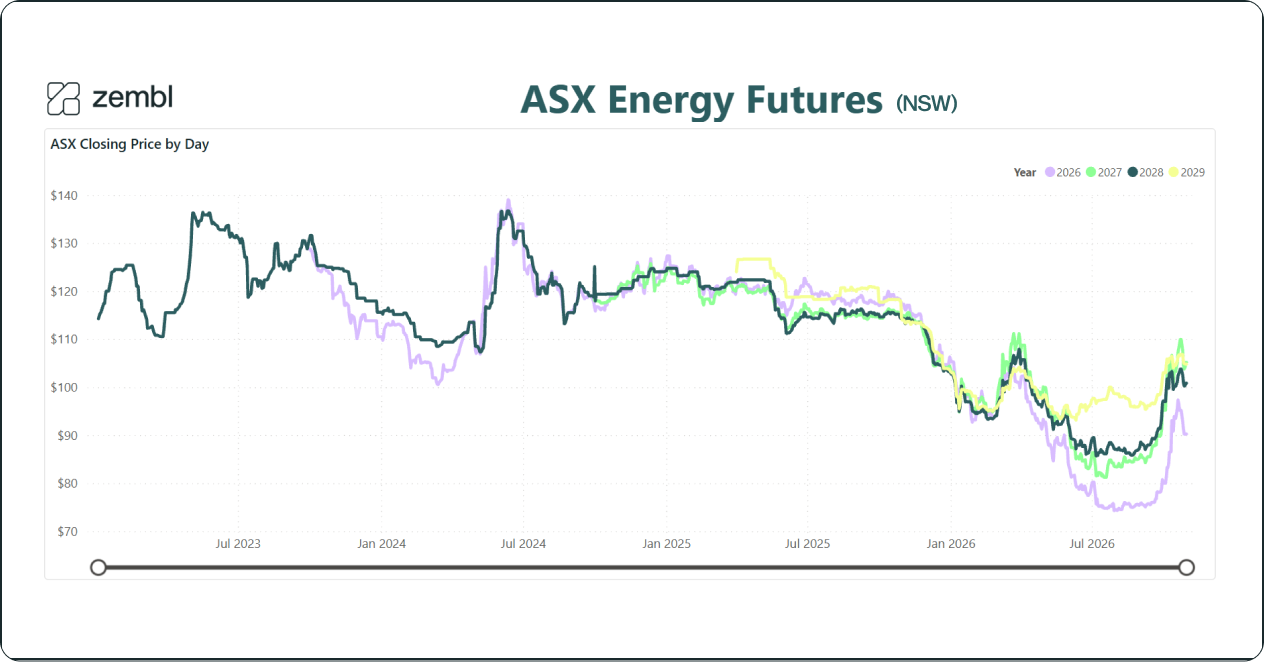
- That is still about 23% below the end of October last year ($117) and about 24% below 2024 ($118).
- Futures peaked just above $97 around 20 October, then eased in the last week of the month.
- Spot prices remain low. AEMO’s September quarter average was $63/MWh, 27% below the same quarter last year.
- Eraring had two units out with tube leaks and Snowy 2.0 slipped to late 2029. Both feed into how the market prices supply from 2027.
Futures prices for 2027 climbed in October. In NSW, the contract opened the month at $80.26/MWh and closed at $90.26/MWh, a rise of $10. All states moved in the same direction. Prices are still well below last year, when the equivalent next-year futures contract was about $117 at the end of October 2025, and about $118 at the end of October 2024.
What influenced the market in October
Coal reliability was back in the news. At Origin’s AGM on 14 October, CEO Frank Calabria said two of Eraring’s four units were offline with tube leaks, with unit 1 due back by 20 October and unit 3 three days later. He also said the plant is generating less electricity than it has historically, and that Origin’s plans still point to closing it in April 2029, according to RenewEconomy. That date isn’t new. Origin moved it from August 2027 to April 2029 in an announcement in January.
On 23 October, Snowy Hydro said the target completion for Snowy 2.0 is now late 2029, a year later than the previous December 2028 estimate, with the cost to complete at $22.2 billion and an allowance for a scenario of up to $25 billion, as reported by The Nightly.
Futures rose through the first three weeks of the month, peaked just above $97 around 20 October, then eased back to $90. We can’t tie the move to any single event. But both stories bear on how reliably NSW can meet demand from 2027.
What’s happening in the NEM (National Electricity Market)
Spot prices have stayed low. AEMO’s latest Quarterly Energy Dynamics report put the NEM average for July to September at $63/MWh, down 27% on the same quarter last year, and the lowest September quarter average since 2021. That happened despite record underlying demand for a September quarter. Gas-fired generation fell 34% to its lowest quarterly average since 2000 (AEMO).
Spot prices reflect electricity traded in the wholesale market for immediate delivery, while futures reflect prices agreed for a future period. That means spot prices can remain low even as the cost of securing electricity for 2027 rises. Batteries are doing more of the work. According to RenewEconomy, grid-scale batteries are now setting the price in nearly half of all intervals.
What we’re watching
Summer supply: Eraring’s two units were due back before the end of October, but tube leaks show how quickly supply can tighten. A heatwave with a coal unit out is the scenario that tends to produce expensive evenings.
NSW firming: On 13 October the NSW government announced a 1.5 GW firming tender. RenewEconomy interprets the tender design as favouring gas peaking plants over batteries and pumped hydro
Mid-scale solar: Solar systems between 100 kW and 1 MW installed from 1 October can now create small-scale technology certificates, which lower the upfront cost. Applications open in mid to late November, according to the Clean Energy Regulator.
What this means for energy buyers
October’s movement reinforces why businesses should review energy contracts well ahead of expiry. Although forward prices remain below comparable levels last year, they can change quickly as market expectations shift.
A move that size shows how quickly forward prices can change. Futures could ease again if summer is mild and batteries keep evening peaks in check, or climb if coal or gas supply disappoints. If your contract expires in the next 12 to 24 months, check where pricing sits now rather than close to expiry. Zembl can take your requirements to market and show you current offers, so you can decide when to lock in.
Sources
- ASX Energy. NSW base futures closing prices, October 2026
- Clean Energy Regulator. Mid-scale solar
- Origin Energy. Origin extends Eraring Power Station operations to 2029 (ASX announcement, 20 January 2026)
- RenewEconomy. Origin sticks by 2029 Eraring closure date
- RenewEconomy. Rooftop PV, wind, solar and batteries bring down prices despite record demand over winter
- The Nightly. Snowy Hydro 2.0 cost could blow out to $25 billion